People often search for the difference between a chauffeur and a driver, assuming the two terms mean the same thing.
A driver gets you from A to B. A chauffeur arrives before you need them, manages the journey around your schedule, holds credentials that are regulated by Victoria's commercial passenger transport authority, and is accountable to a service standard that applies to every booking, not just the ones where things go smoothly.
The confusion is understandable. Both involve a person and a vehicle. But the role, the training, the regulatory framework, and the service model are different in ways that matter considerably when punctuality, safety, and the passenger experience are not optional.
In Victoria, the distinction also carries legal weight. A Chauffeur Top operating a commercial passenger vehicle must hold CPVV accreditation, a commercial driver's license, and current background clearances that are not required of a rideshare operator or private driver. That framework exists for a reason.
This guide explains exactly where the two diverge in credentials, vehicle standards, service responsibilities, pricing, and what the difference actually looks like the moment your plane touches down.
 Difference Between a Chauffeur and a Driver
What a Driver Is
A driver is any person who operates a motor vehicle to transport passengers or goods. The term applies across many contexts taxi drivers, rideshare operators, delivery drivers, and informal private arrangements. The baseline requirement is a valid driver's license and compliance with road rules. Responsibilities and standards vary widely by context, and no consistent professional standard is implied by the word alone.
What a Chauffeur Is
A chauffeur is a professionally trained and licensed operator of a luxury passenger vehicle. The role extends well beyond driving. A chauffeur manages the passenger experience, vehicle presentation, punctuality, luggage assistance, route management, passenger comfort, and communication conducted on the passenger's terms.
The word originates from the French word for "stoker" , the person who tended the engine of early steam-powered vehicles. Over time, it evolved to describe the professional driver of a privately hired vehicle. In Australia, the title carries specific regulatory meaning and service expectations that are not present in the broader category of "driver."
Where the Differences Show Up
Credentials and Regulation
In Victoria, operating a commercial passenger vehicle for hire requires CPVV accreditation, the standard set by Commercial Passenger Vehicles Victoria, the state's regulatory authority for all for-hire transport. A professional chauffeur service goes further.
Every chauffeur in the Chauffeur Top network holds all five of the following before accepting a single booking:
Commercial driver's license (mandatory for all commercial passenger operations in Victoria)
CPVV accreditation (Commercial Passenger Vehicles Victoria)
VHA accreditation (Victorian Hire-Car Association)
Current National Police Clearance
Working with Children Check
A rideshare operator completes a platform background check. The regulatory standard is different and in most cases, the vehicle is the driver's personal car rather than a commercially insured fleet vehicle. These are not equivalent frameworks.
Training and Service Scope
A driver's responsibility is to transport the passenger safely. A chauffeur's responsibility is to manage the entire journey.
That distinction in scope reflects a difference in training. A chauffeur is trained in passenger etiquette when to speak and when to stay silent, how to manage last-minute itinerary changes without prompting from the passenger, how to handle luggage, and how to adapt communication style to the person in the back seat. For airport transfers, that training includes real-time flight monitoring: tracking the passenger's departure, adjusting the pickup schedule automatically for delays or early arrivals, and ensuring the driver is waiting not on the way.
These are not optional extras. They are part of how a professionally trained chauffeur operates on every booking.
Vehicle Standards
Chauffeurs operate late-model luxury vehicles maintained to a commercial standard. The Chauffeur Top fleet includes Mercedes-Benz, BMW, and Audi vehicles, executive sedans, premium sedans, luxury SUVs, and people movers , under a rolling replacement cycle that keeps every vehicle generally within three to four years of production.
A driver may operate in a personal vehicle, a basic fleet car, or a standard sedan. The standard is determined by the operator or the app platform. No regulated requirement governs vehicle age, condition, or class.
Appearance and Conduct
A professional chauffeur presents in formal attire and follows specific conduct standards: opening doors for passengers, assisting with luggage, adjusting climate controls without being asked, and maintaining a quiet, composed manner throughout the journey. The cabin default is silence; the driver does not initiate conversation unless the passenger does.
This is a professional standard, not a formality. It makes a business transfer quieter, a late-night return home more composed, and an arriving international guest's first minutes in Melbourne considerably more settled.
Pricing and the Booking Model
A taxi or rideshare operates on a metered or estimated fare. The price adjusts based on distance, time, traffic, and demand. Surge pricing is real during Melbourne's peak hours, major events, or after midnight, estimated fares climb in real time.
A chauffeur service operates on fixed pricing. The fare is agreed at the time of booking. It does not change based on traffic, time of day, weather, or any other variable after confirmation. The price you confirm is the price on the invoice.
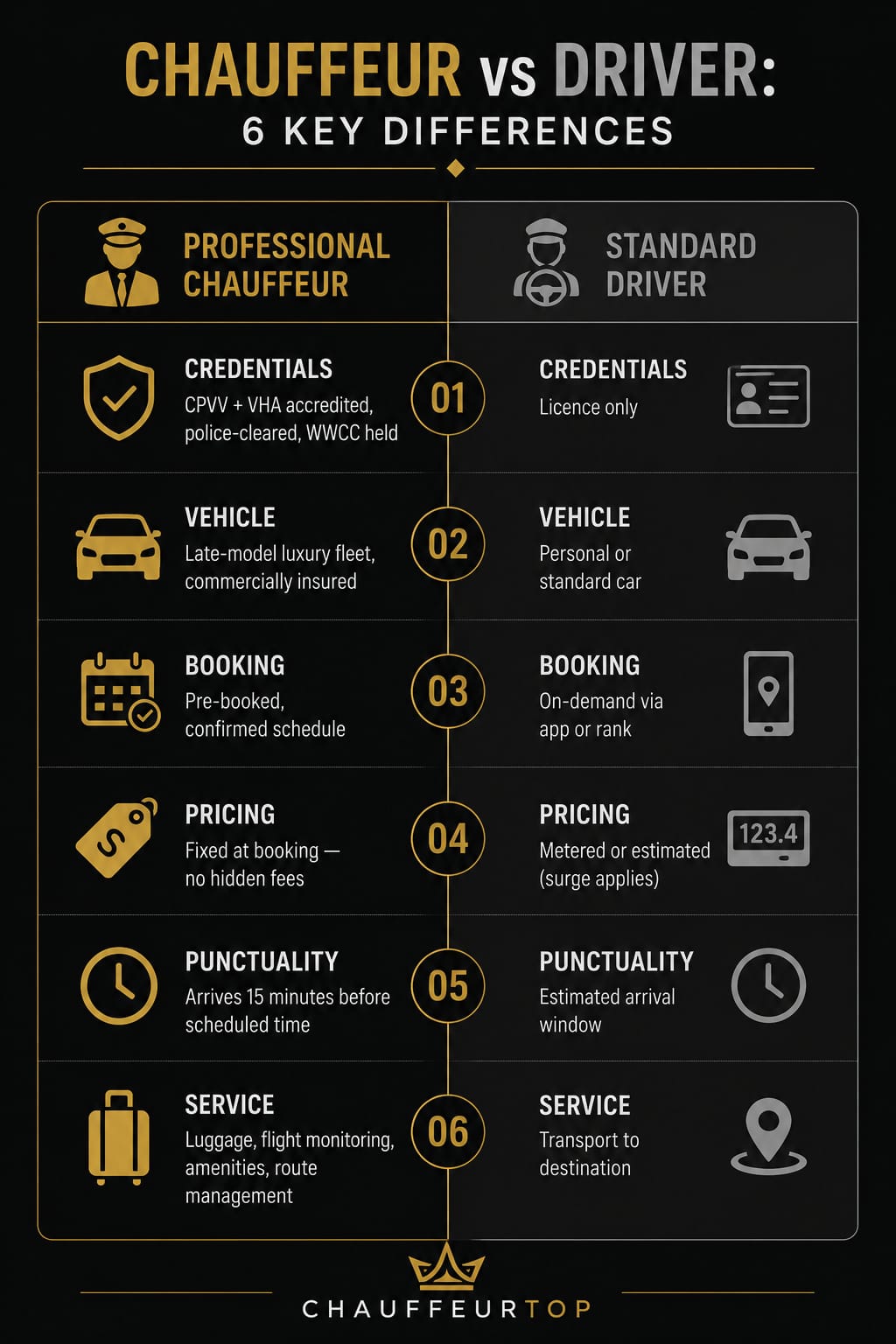
Chauffeur vs Driver at a Glance
Professional Chauffeur | Standard Driver | |
Credentials | CPVV-accredited, police-cleared, WWCC held | License only (standard varies by platform) |
Vehicle | Late-model luxury fleet, commercially insured | Personal or standard vehicle |
Booking model | Pre-booked, confirmed schedule | On-demand |
Pricing | Fixed at booking no hidden fees | Metered or estimated (surge possible) |
Punctuality | Arrives 15 minutes before scheduled time | Estimated arrival window |
Service scope | Luggage, flight monitoring, amenities, route management | Transport to destination |
The Regulatory Context in Melbourne
Melbourne's commercial passenger transport sector is overseen by Commercial Passenger Vehicles Victoria (CPVV). CPVV accreditation is a legal requirement for any operator providing commercial passenger transport for a fee. The Victorian Hire-Car Association (VHA) sets a further professional standard for licensed hire-car operators.
Together, these frameworks mean that booking a CPVV and VHA-accredited chauffeur service in Melbourne is not simply a quality choice, it is a regulated one. The driver has passed background checks that are a legal requirement of their operating license. The vehicle is commercially insured to a standard that differs from the personal insurance carried by a rideshare driver. The operator is accountable to a governing body.
For more on how chauffeur services compare to taxis in Melbourne's regulatory environment, see How a Chauffeur Service in Melbourne Differs From a Regular Taxi.
What It Looks Like in Practice
The clearest illustration is the airport pickup.
You land at Melbourne Airport after a delayed overnight flight from Sydney. Your phone has a 4 per cent battery. You have a 9 am meeting in the CBD.
With a rideshare: you open the app, wait for a car to become available, watch the estimated fare climb in peak-hour traffic, and load your bags yourself.
With a professional chauffeur: the driver has been tracking your flight since departure. They already know you landed at 7:43 instead of 7:15. They are in the arrivals hall with a name board before you reach the carousel. Luggage is handled. The vehicle is ready. You are on the road within minutes of clearing customs at the price confirmed when you booked. See Melbourne airport transfer service for more detail on how the pickup process works.
Always provide your flight number at the time of booking not the night before. Chauffeur Top's flight monitoring begins at the moment your flight departs, not at the scheduled landing time. The 15-minute early arrival policy is calculated against real-time flight data. If your plans change after booking, call (04) 3024 0945 to update your travel details directly with the dispatch team.
When the Distinction Matters Most
Not every journey requires a chauffeur. A short local trip is exactly what a rideshare is built for.
The distinction becomes consequential when:
Punctuality is non-negotiable, airport transfers, board meetings, weddings, legal appointments
The passenger experience is being judged, a corporate client, a visiting executive, a senior guest
Safety standards matter beyond convenience, family arrivals, student transfers, late-night pickups
The price must be known in advance, expense reporting, event budgets, corporate account billing
In these situations, the service model and regulatory standing of a professional chauffeur are not a premium. They are the appropriate standard. For corporate travel specifically, see corporate chauffeur service Melbourne.
Who Books a Professional Chauffeur
Corporate travellers who need the time between meetings to be productive, not spent parking or waiting for a car.
Families with confirmed arrival times, luggage, and children who need car restraints arranged in advance.
Event guests and hosts who are working to a fixed schedule and cannot absorb an unpredictable wait.
International visitors arriving in Melbourne for the first time who need a confirmed vehicle, a confirmed price, and a driver who already knows their name before they reach the exit.
The Bottom Line
The difference between a chauffeur and a driver is not about the vehicle or the suit. It is about training, credentials, service responsibility, and the regulatory framework that sits behind every booking.
A driver handles transport. A chauffeur handles the journey from the fixed price confirmed at booking to the moment you step out of the vehicle. For Melbourne airport transfers, corporate travel, private tours, and any situation where the standard of service is not negotiable, that distinction is worth understanding before you book.
Book at chauffeurtop.com.au/booking or call (04) 3024 0945 — 24 hours, 7 days.